Portfolio
Introduction
Genres are populous hubs in compositional space. Between and around these hubs, fading in radiating gradients of population density, are exurban expanses giving way to wilderness. The three works I have chosen to include here show processes I apply to genre, or to compositional space itself, in my artistic practice. In How to Relax with Origami, inspired by the idea of making origami figures from the comic strip page of a newspaper, I fold compositional space. Once-distant genres find themselves touching, and so the piece brims with sudden juxtapositions. In moments where genres overlap temporally, I design the texture for them not to fuse but rather to remain tensely at odds. Spaiksa, on the other hand, is about interpolation. The piece begins near one cluster of genres and makes its way towards another via points that bridge the origin and destination. Finally, the composition Closed Fingers Catch the Sand is a kaiju born in the compositional wilderness. Characteristics it shares with any genres it acquired through mastication and digestion.
How to Relax with Origami (2017)
Length: 12 minutes
Instrumentation: orchestra
(The score, to the right, contains a detailed instrumentation breakdown and program notes.)
How to Relax with Origami is pervaded by irony. I am relieved that aspect of it was apparent (if not necessarily lauded) by many who experienced it, exemplified by Harvey Steiman in his review for The Aspen Times where he stated, ”How to Relax With Origami” [is] a deceptively carefree title for a piece bubbling with dark undertones and sharp humor.” Nevertheless, with the passage of time, I have come to doubt that How to Relax with Origami was a meaningful form of protest or solidarity. That lesson continues to inform my work.
I wrote Spaiksa for Egemen Kesikli, a multi-instrumentalist and vocalist, and for Maureen Bailey, Maxwell J. McKee, and John Boggs, vocalists. Egemen and I are frequent collaborators, especially through his band Turkish Massage Owl, which performs folk and pop music with roots in West Asia, while Max, John, and I once constituted vocal trio Beartooth Scrimshaw, which was dedicated to singing music from the Republic of Georgia.
Spaiksa interpolates between two broad genre-spaces, beginning near the complex, rich world of West Asian folk music and arriving towards progressive metal. An ephemeral coda briefly merges them. The piece’s microtonal pitch-set is inspired by makam but nowhere does the piece conform seyir (formal melodic contour), instead striking out on its own idiosyncratic path.
I generated the text for Spaiksa with a Python console app that I built for this project: nonlang.py outputs words devoid of conceptual content and with no phonemic analog in a crowd-sourced Wiktionary database of natural languages transliterated into IPA. As part of generating words, nonlang.py checks its algorithmically-generated phoneme strings against the database, then discards and replaces any strings with a match. Its final output, then, consists of words whose phonemic content is (ostensibly) not in use in any of those transliterated natural languages. I deploy these words as blank slates with no referential meaning so that they can take on their own abstract, musical meaning in the context of the piece.
Below is an example of an input I composed for nonlang.py. The numbers on the left represent syllable counts and the asterisks determine which words will rhyme (all one asterisk words will rhyme, all two asterisk words will rhyme, and so on). To the right are two different outputs it returned when fed that input twice.
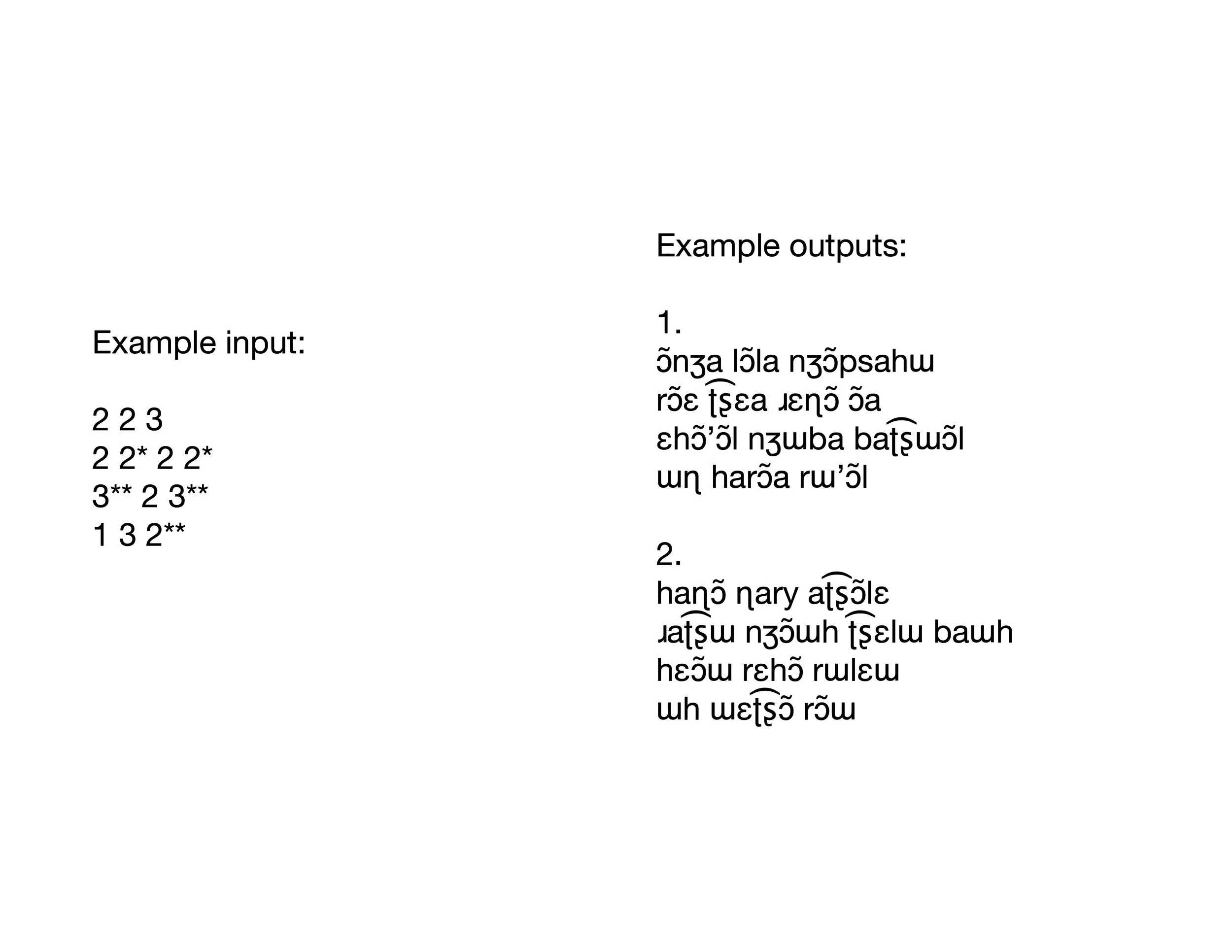
While composing with this tool there were a variety of creative processes that I carried out, including:
1. Devising syllable counts and rhyme schemes matched to melodic and rhythmic gestures
2. Crafting custom subsets of IPA phonemes for nonlang.py to draw from when generating text for given passages
3. Selecting from (and often swapping words between) many successive returns until I was satisfied with its musical affect relative to its context in the composition.
Below is the complete text set in Spaiksa:
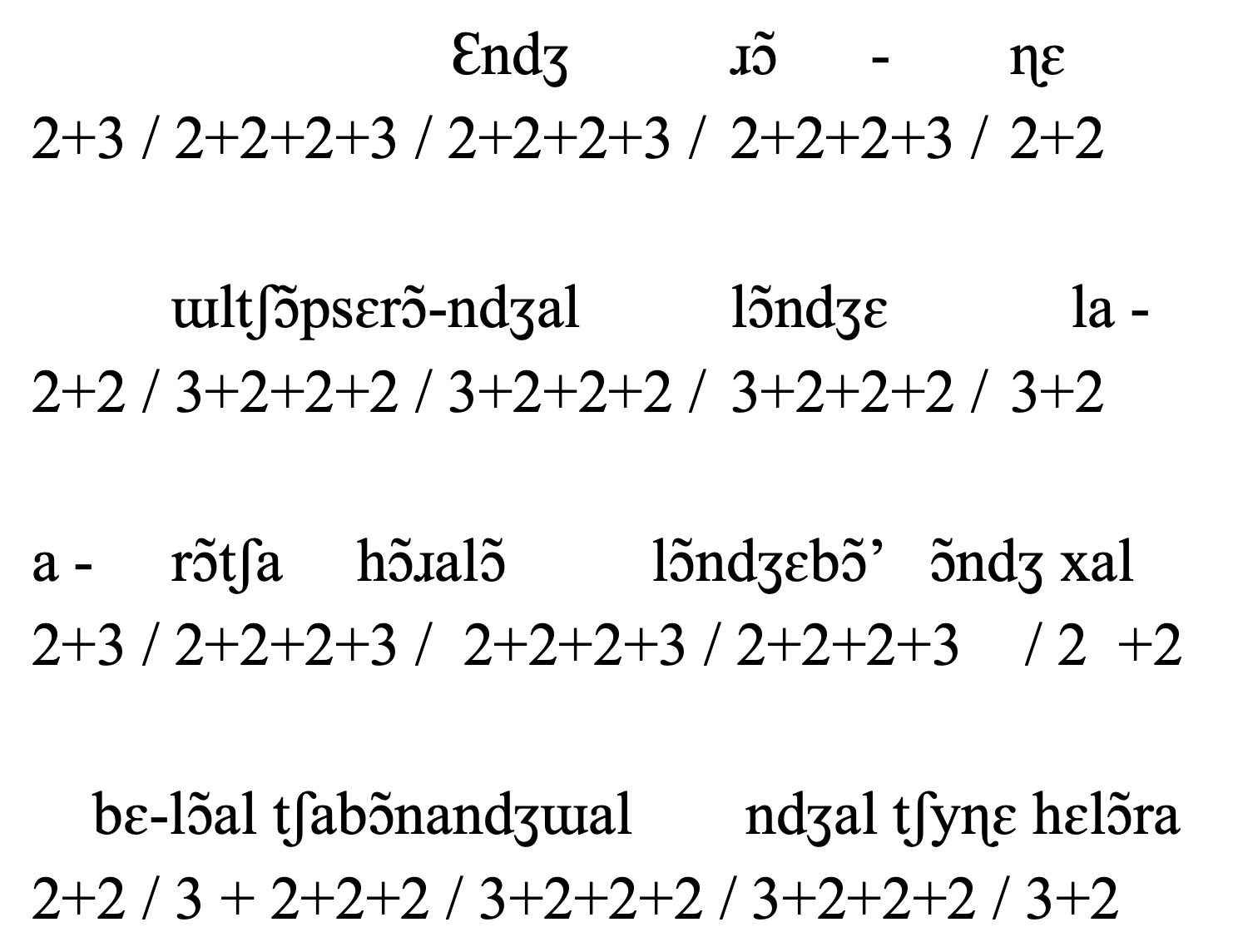
In keeping with the oral/aural traditions of the genres this piece is inspired by, the performers of Spaiksa learned their parts by ear. However, I supplied them memory aids for the recording session, but not in staff notation, as the rhythmic complexity of the material proved unwieldy in that system. Instead I developed a shorthand conveying only the rhythmic counts the performers had already internalized with a visual indication of the placement of the text relative to those counts. For example:
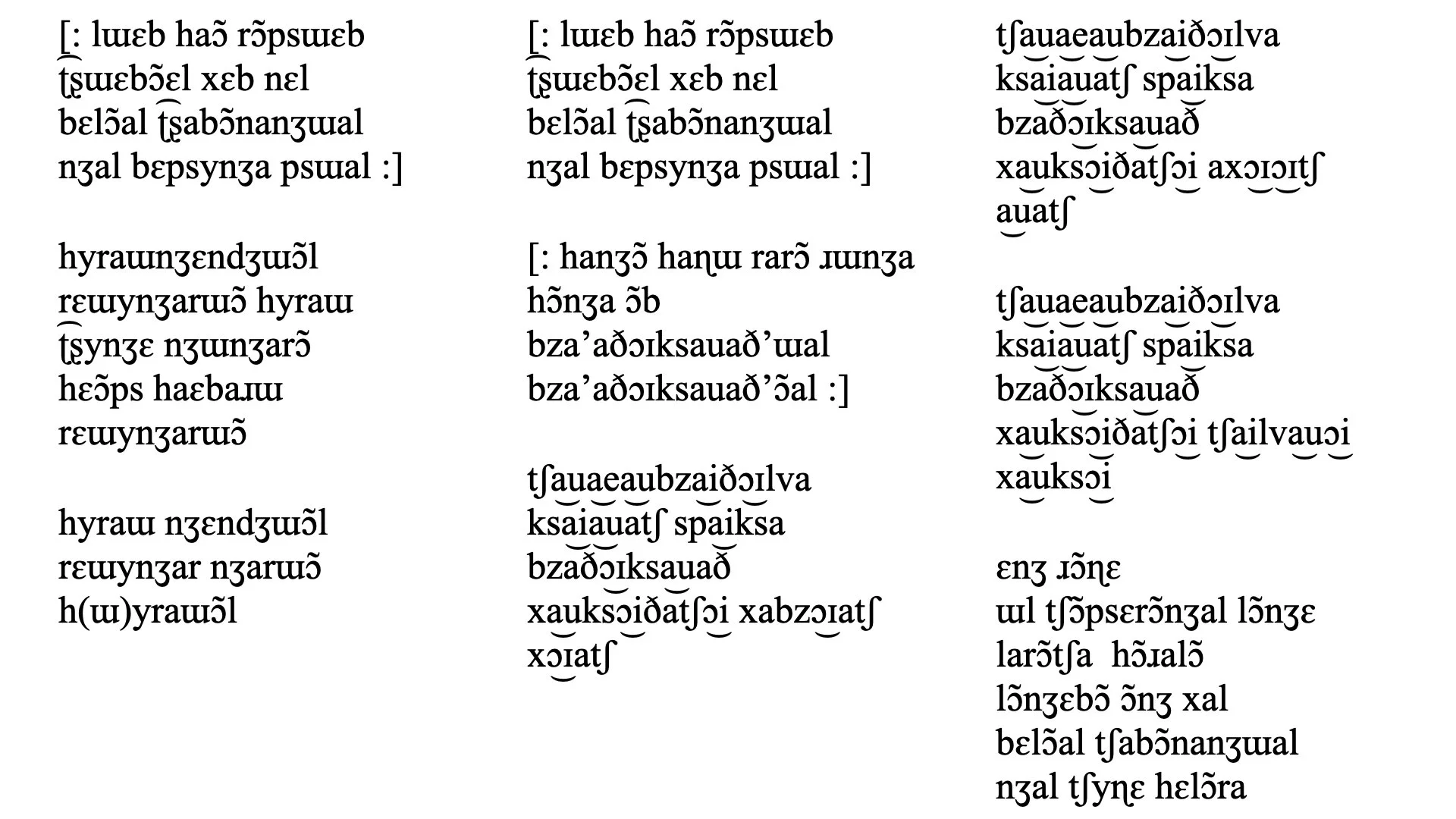
(There is no score for this piece.)
Spaiksa (2023)
Length: 8 minutes
Instrumentation: Percussion (davul, erbane, udu, drum kit, shakers), Serge modular and digital synthesizers, 5 vocalists, oud, electric guitar, electric bass
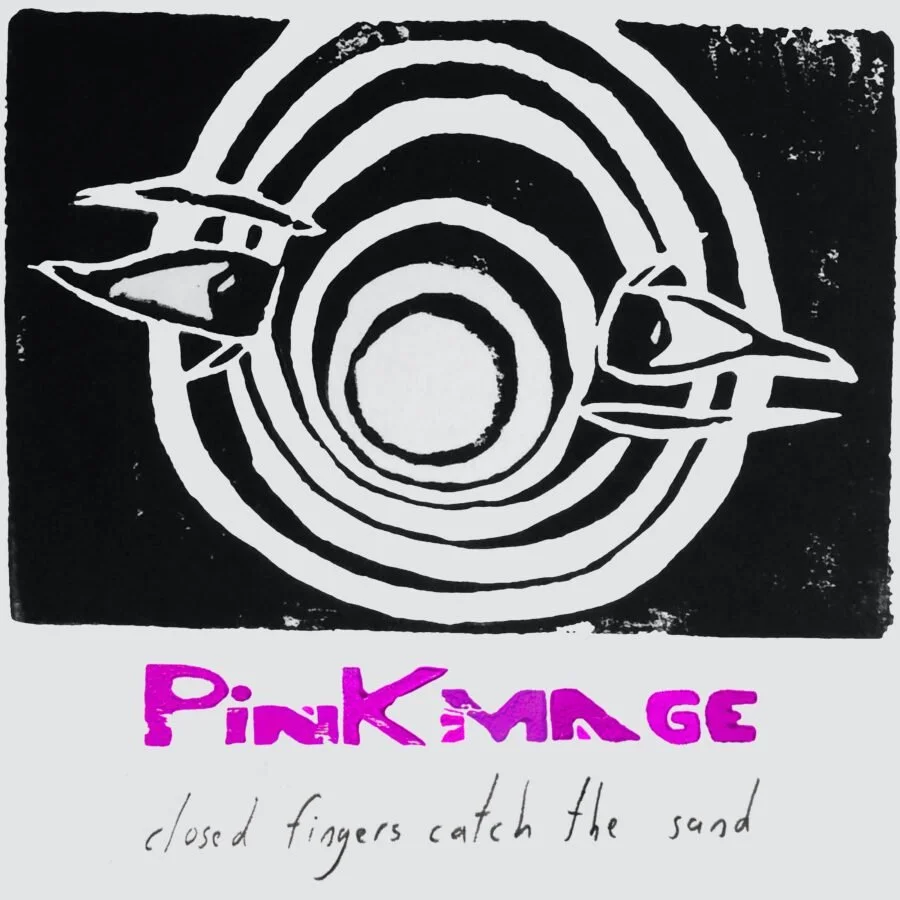
Closed Fingers Catch the Sand (awaiting release in 2026)
Length: 50 minutes
Note: It takes a moment for each audio file to load after pressing play.
I created this eight-movement suite by overdubbing and editing numerous layers of material performed with a Serge modular synthesizer routed through a PodXT multi-effects pedal. Granular synthesizer, voice, clarinet, electric guitar, and shaker are occasionally employed for particular gestures. Key elements I considered in the compositional process were timbre, stereo spatialization (the depth field in particular), and form through large-scale spectral morphology. I asked Anthony Kingsley, a colleague of mine in the collective Pink Mage, to master the recording and to pay particular attention to a process we dubbed “enfilthification”.
The piece is attuned to past, present, and future dystopian characteristics of the American West, channeling what it is like to feel a deep, primal love for a place but then to experience that place variously leveled, burnt, overrun, trashed, closed off, and washed away. In other words, it is a sonic reification of civilization-as-kaiju, but with no camp or irony. “The memory of the recent beauty remains, and the imagined sublimity long before civilization disturbed the land is ever-present, and hope for the future, while slight, pushes back against the malaise and dread of the present.”